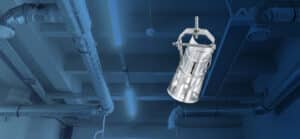
Does this sound familiar? You walk into the warehouse on Monday morning, and there they are—pipe shields lying on the floor instead of protecting the insulation where they belong. It’s frustrating. You spec’d the right product, ordered it on time, and somehow it still didn’t stay put.
The truth is, most shield failures aren’t mysterious. They happen for predictable reasons, and once you understand what’s going wrong, you can prevent them. While proper design, specification, and installation all play a role, many shield failures stem from predictable field conditions that can be addressed without changing the entire system design.
The Most Common Failure Modes
Slipping From Single-Point Attachment
Traditional pipe shields rely on a single attachment point—usually a piece of strapping or wire. In many installations—particularly on larger pipe, higher-temperature systems, or in vibration-prone environments—that single point of contact can become a single point of failure.
Thermal expansion and contraction cycles cause pipes to shift. The shield that was tight on Tuesday is loose by Friday. Once it starts moving, gravity and vibration do the rest. While single-point attachment can work in low-vibration environments with small-diameter pipe and properly torqued hangers, it becomes less reliable as system demands increase.
Vibration Wear
In facilities with heavy equipment, HVAC systems, or process machinery, constant vibration gradually loosens even the best attachment methods. According to the National Insulation Association’s installation guidelines, improper hanger selection and treatment can negatively impact thermal performance and lead to mechanical failures over time.
The vibration doesn’t have to be dramatic. Small, constant movement is enough to work a wire tie loose or stretch out strapping over weeks and months.
Thermal Cycling Stress
Hot pipes expand. Cold pipes contract. This cycle repeats thousands of times over a system’s lifetime. Each expansion-contraction cycle puts stress on the shield attachment points.
On systems with wide operating temperature swings—such as high-temperature process piping or systems subject to frequent cycling—materials that work fine in stable conditions can fail prematurely. The shield material itself might hold up fine, but the attachment method gives out under repeated thermal stress.
Corrosion at Contact Points
Even galvanized shields can corrode at the points where they’re attached—especially if dissimilar metals are in contact or moisture gets trapped. ASTM G189, which addresses laboratory simulation of corrosion under insulation, illustrates how moisture and elevated temperatures can accelerate corrosion in insulated piping systems—conditions that can also compromise shield attachment points over time.
When the wire or strap corrodes through, the shield has nothing holding it in place.
What to Look for in a Better Shield
If you’re tired of dealing with shield failures, here’s what actually makes a difference:
Multiple Retention Points
Shields with two or three independent attachment options provide redundancy. Think of it as an insurance policy built into the design where you can pick the best attachment method for the job.
Some modern shields are engineered so you can use strapping, a bolt, or wire—whichever works best for your installation conditions. Having options means you’re not fighting the design to make it work on your jobsite.
Edge Design That Protects Installers and Insulation
Sharp edges are a double problem. First, they pose a safety hazard to installers who handle them. Second, they tear insulation jackets, leading to moisture intrusion and a loss of insulation performance.
Look for shields with rounded or beveled edges. It’s a simple design feature that makes a real difference in both safety and long-term performance.
Material Thickness and Quality
Not all galvanized steel is created equal. A thinner-gauge metal saves money upfront but doesn’t withstand the stresses we’ve been talking about—vibration, thermal cycling, and mechanical loads.
The ASTM C1696 Standard Guide for Industrial Thermal Insulation Systems emphasizes the need for coordination between mechanical design and insulation systems, noting that mechanical piping design may need to be modified to adequately support insulation and prevent system failures.
Proper Sizing
A shield that’s too small won’t protect the insulation. A shield that’s too large allows movement, which leads right back to the failure modes we’re trying to avoid.
Make sure you’re matching shield dimensions to your actual pipe and insulation diameter—not just estimating or reusing what worked on the last job. Proper sizing considerations should account for both the insulation protection requirements and the structural support needs outlined in standards like MSS SP-58 (Pipe Hangers and Supports).
The Real Cost of Shield Failures
It’s easy to think of a fallen shield as a minor inconvenience. But consider what actually happens:
- Lost productivity: Someone has to stop what they’re doing to retrieve and reinstall it
- Damaged insulation: Once the shield is gone, the hanger crushes the insulation
- Thermal performance loss: Compressed or damaged insulation doesn’t insulate properly
- Callbacks: If it happens after you’ve finished the job, you’re coming back on your dime
- Safety risks: Shields falling in active facilities can create hazards
In high-stakes environments like warehouses with automated systems, a single failed shield that falls onto a conveyor or into equipment pathways can shut down operations. The actual cost isn’t the shield—it’s the downtime.
What You Can Do Right Now
If you’re experiencing shield failures on your jobs, here are some practical steps:
- Review your attachment method. Are you relying on a single wire tie when you could add a strap for backup?
- Check your shield sizing. Measure your installed pipe and insulation diameter and verify you’re using the correct shield size.
- Inspect existing shields. Look for early warning signs—slight movement, corrosion at attachment points, or loosening.
- Consider upgrading critical systems. Not every pipe needs the most robust solution, but your main distribution lines, high-temperature systems, and anything in a high-vibration environment deserve better than the bare minimum.
- Document what works. When you find a combination of shield and attachment method that holds up well, make a note of it. Build that knowledge into your specs for next time.
The Bottom Line
Pipe shields fail when they’re not designed or installed to handle real-world conditions. Thermal cycling, vibration, and corrosion aren’t edge cases—they’re normal operating conditions for most mechanical systems.
The good news is that these failures are preventable. With the right design features and proper installation techniques, shields can stay in place for the life of the system. You shouldn’t have to wonder if your shields are going to be on the floor the next time you visit the site.
Ready to upgrade your pipe shield game? Explore our full line of pipe shields designed for real-world conditions, or request a sample kit to see the difference hands-on.
Additional Resources
- National Insulation Association – Installation Guidelines
- ASTM C1696 – Standard Guide for Industrial Thermal Insulation Systems
- ASTM G189 – Corrosion Under Insulation Testing
- MSS SP-58 – Pipe Hangers and Supports – Materials, Design, Manufacture, Selection, Application, and Installation
- Insulation Components Product Data Sheets